



Most single-family investors and Realtors aren’t reading institutional market research. They’re leasing homes, advising clients, and trying to understand why renters suddenly feel slower, pickier, or more willing to negotiate than they were a year ago. That change in behavior isn’t random. It’s being driven by forces most people never see — but renters feel immediately.
What CoStar Is Showing
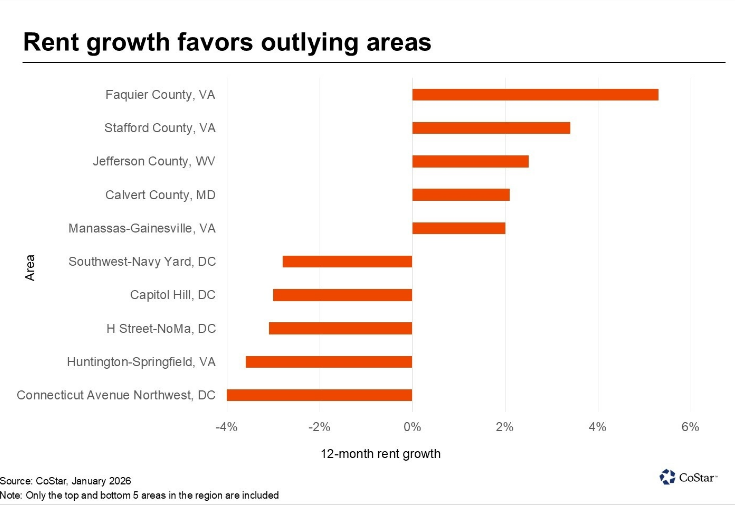
In a January 2026 report, CoStar Analytics highlighted a growing split in the Washington, DC rental market:- Metro-wide multifamily rents declined 0.9% year-over-year
- Urban, high-supply submarkets saw the steepest rent declines, including:
- Connecticut Avenue NW: -4.0%
- H Street / NoMa: -3.1%
- Huntington–Springfield, VA: -3.6%
- Fairfax City–Oakton: -3.0%
- Vacancy surged where new apartment supply concentrated:
- Southwest–Navy Yard vacancy reached 15.5% after nearly doubling inventory
- To compete, many new apartment communities are offering two to four months of free rent
- Fauquier County, VA: +5.3%
- Stafford County, VA: +3.4%
- Jefferson County, WV: +2.5%
Why This Matters for Single-Family Rentals
Apartment rent declines do not mean renters disappeared. They mean renters gained choice. When vacancy rises and concessions spread in the apartment market, renter behavior changes quickly:- Renters compare more options
- They take longer to decide
- They negotiate harder
- They walk away from homes that feel misaligned on price or value
How This Shows Up in the Single-Family Market
In Northern Virginia’s single-family rental data, pressure rarely shows up as dramatic rent drops. It shows up as friction:- Longer days on market
- Wider gaps between asking and accepted rent
- More negotiation
- Larger performance differences between well-priced and mispriced homes
The Mistake People Would Make If They Read the Headlines Wrong
If someone skimmed the CoStar article without context, they might assume:“Rents are falling — this must be bad for rentals.”That’s the wrong conclusion. What the data actually shows is a leverage shift, not a demand collapse. And leverage shifts don’t punish ownership — they punish pricing errors, slow execution, and outdated assumptions.
Why We Track This — And Translate It
At Real Property Management Pros, we follow institutional research like CoStar deliberately — not because apartments determine single-family rents, but because apartments shape renter expectations first. Our Northern Virginia Rental Market Analysis – January 2026 uses multifamily data as context, not prediction:- To identify where renter leverage is building
- To anticipate friction before it turns into vacancy
- To help owners and Realtors adjust strategy early, not defensively
What This Means for Smarter Decisions in 2026
- This is not a weak-demand market — it’s a high-choice market
- Pricing accuracy matters more than ever
- Small pricing errors now cost time, not just pride
- Execution quality is the real differentiator
The Bottom Line
You don’t need more headlines. You need explanations that make renter behavior make sense. Because by the time the market feels obvious, the opportunity to respond intelligently has already passed.— Marc Blackwood
President, Real Property Management Pros
Source: CoStar Analytics, “Outer DC suburbs top urban areas in multifamily rent growth,” January 9, 2026; interpreted alongside executed MLS leasing outcomes from RPMP’s Northern Virginia Rental Market Analysis – January 2026.