


For many Northern Virginia landlords, the real number isn’t where they’re looking on the spreadsheet. It appears in the extra week a unit sits empty, the maintenance call pushed back until it’s a bigger repair, the tenant does not renew, and the hours never get logged anywhere. This guide walks through where that cost actually hides, and how to run the numbers on your own property before deciding.
For some owners, DIY property management is a deliberate choice. They want direct control, they live close to the property, and have time to handle leasing, rent collection, tenant communication, and repairs themselves. The question is whether the savings still hold up once all hidden costs are accounted for.
Quick Answer: What Does Self-Managing a Rental Property Really Cost?
There is no management fee when you self-manage, but there is rarely no cost. The real cost is your own time, priced at whatever your hour is worth; a longer average vacancy while you handle leasing and screening around a job and a life; deferred maintenance that costs more the longer it waits; and a lower renewal rate if a tenant’s experience is inconsistent. Add those up against a typical Northern Virginia management fee, and self-managing is sometimes still the right call, and sometimes it’s not. It depends on your property, your time, and your tolerance for the parts of the job that do not become visible until something goes wrong.Key Takeaways
- Self-managing has no line-item fee, but it’s not free. The cost is visible as time, vacancy days, deferred maintenance, and turnover rather than a monthly invoice.
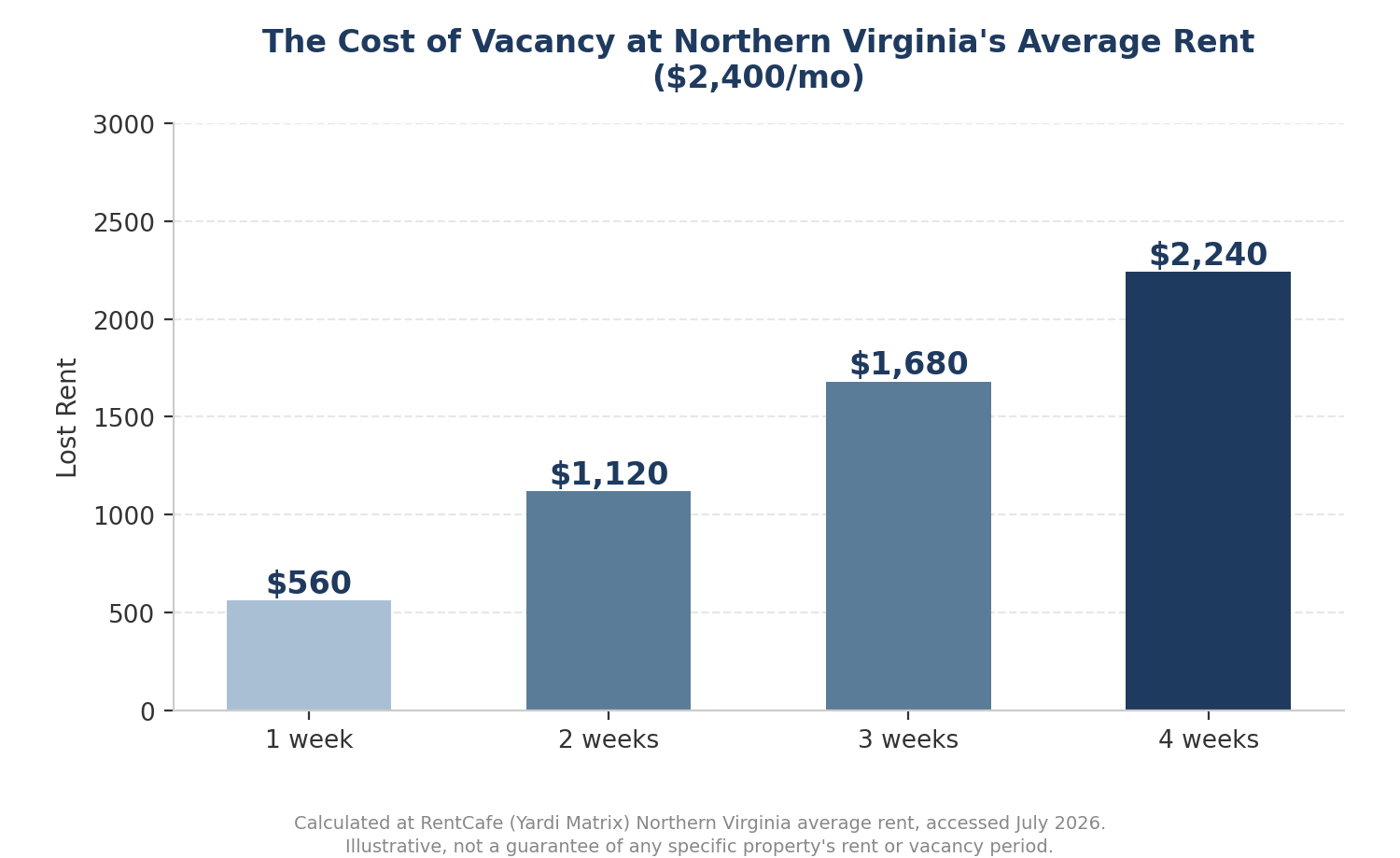
- Two weeks of vacancy on a typical Northern Virginia rental at the region’s average rent is over $1,100 in lost income, money that a slower self-managed leasing process can lose without the landlord tracking it as a cost.
- Your own time has a real dollar value. Pricing it honestly, at whatever your hour is actually worth, is the single most commonly skipped step in a landlord’s self-management math.
- Deferred maintenance and inconsistent tenant screening carry costs that often surface months later, in a bigger repair bill or a tenant who does not renew, not at the moment the corner gets cut.
- The right answer is property-specific. One rental five minutes from home with a flexible schedule is a very different equation than a portfolio, a remote property, or a landlord with a demanding job.
The Time Cost Nobody Puts on a Spreadsheet
Self-managing means you’re the leasing agent, the screener, the rent collector, the maintenance coordinator, and the person who answers the phone when a tenant calls on a Sunday. None of that appears as an actual cost until you sit down and total the hours.If you want a fuller breakdown of the responsibilities that fall on the owner when there is no management company involved, read our guide to what a property manager does.
Here is the real-world way to price it. List out what you handled last month: marketing the vacancy, fielding inquiries, showings, reviewing applications, coordinating a repair, chasing a late payment, or just reading and responding to tenant texts. Add up the hours. Multiply by what your time is actually worth, whether that’s your hourly wage, what you bill clients, or simply what an evening or a Saturday is worth to you. That number is your real management cost. It just isn’t on an invoice.
This is the same math to run before comparing your total to the management fee on our property management cost page. A fee that looks expensive next to “free” often looks different next to your own hourly rate.
Managing Your Own Rental Property: What You’re Really Taking On
Managing your own rental property means becoming the first point of contact for every part of the tenancy. You’re responsible for marketing the property, responding to inquiries, showing the home, screening applicants, collecting rent, handling late payments, coordinating repairs, documenting maintenance, tracking expenses, and staying up to date with Virginia landlord-tenant requirements.For a well-maintained property with a reliable long-term tenant, that workload may be manageable. During a vacancy, turnover, maintenance emergency, or tenant dispute, the time requirement can change quickly.
The Cost of Vacancy When Leasing Slows Down
A vacant unit costs money every single day it sits empty, and self-managing tends to add days to that count. Marketing has to fit around your schedule. Showings have to be arranged one at a time instead of through a coordinated process. Applications have to be reviewed and verified without a dedicated screening system. None of that is a knock on any individual landlord. It’s simply slower to do part-time than it is for a team doing it every day.The math is straightforward once you put a real Northern Virginia rent figure against it. Using a rough Northern Virginia rent figure of $2,400 a month, every week a unit sits empty costs about $560 in lost income. Two weeks is over $1,100. A full month is the entire month’s rent, gone, before you have spent a dollar on anything else.
“Vacancy usually adds up in small pieces: a week here, a few days there, lost to a slower leasing process. Most landlords don’t add it up until it is already real money, and it’s already happened.” Marc Blackwood, Real Property Management Pros
What Happens When Maintenance Gets Deferred
Every landlord intends to handle maintenance promptly. In practice, self-managing means maintenance competes with your job, your family, and everything else in your week, and the temptation to push a repair to next weekend is real. The problem is that most maintenance issues do not stay small while they wait. A slow leak becomes water damage. A minor HVAC issue becomes a full breakdown in the middle of a Virginia summer. A repair that would have cost a few hundred dollars, caught early, can cost several times that amount once it is deferred.Self-managing landlords are also working without an established vendor relationship, which means calling around for availability and paying retail rates on emergency work rather than a pre-negotiated rate. For a fuller breakdown of landlord repair obligations, read our guide to what maintenance you are responsible for as a landlord.
The Screening and Compliance Risk You’re Carrying Alone
Placing the wrong tenant is one of the most expensive mistakes a landlord can make, and it is also one of the easiest to make when screening is squeezed into a busy week rather than run as a consistent process every time. A missed step in verifying income, a skipped call to a previous landlord, or a document that looks right but was not properly checked can lead to a tenant who does not pay reliably, damages the property, or has to be evicted.Virginia landlord-tenant law adds another layer that self-managing landlords have to track on their own: fair housing requirements, notice periods, and security deposit handling all carry real legal exposure when they are handled inconsistently. The risk is being unable to show that every applicant was evaluated against the same written criteria. Rent collection is another area where consistency matters. Our guide on how to collect rent effectively explains how written policies, payment systems, and late-payment procedures help protect landlord cash flow.
We cover what a structured, compliant screening process actually involves on our professional tenant screening page.
Related Reading: Why Tenant Screening Is So Important
Renewals: The Cost You Don’t See until the Tenant Leaves
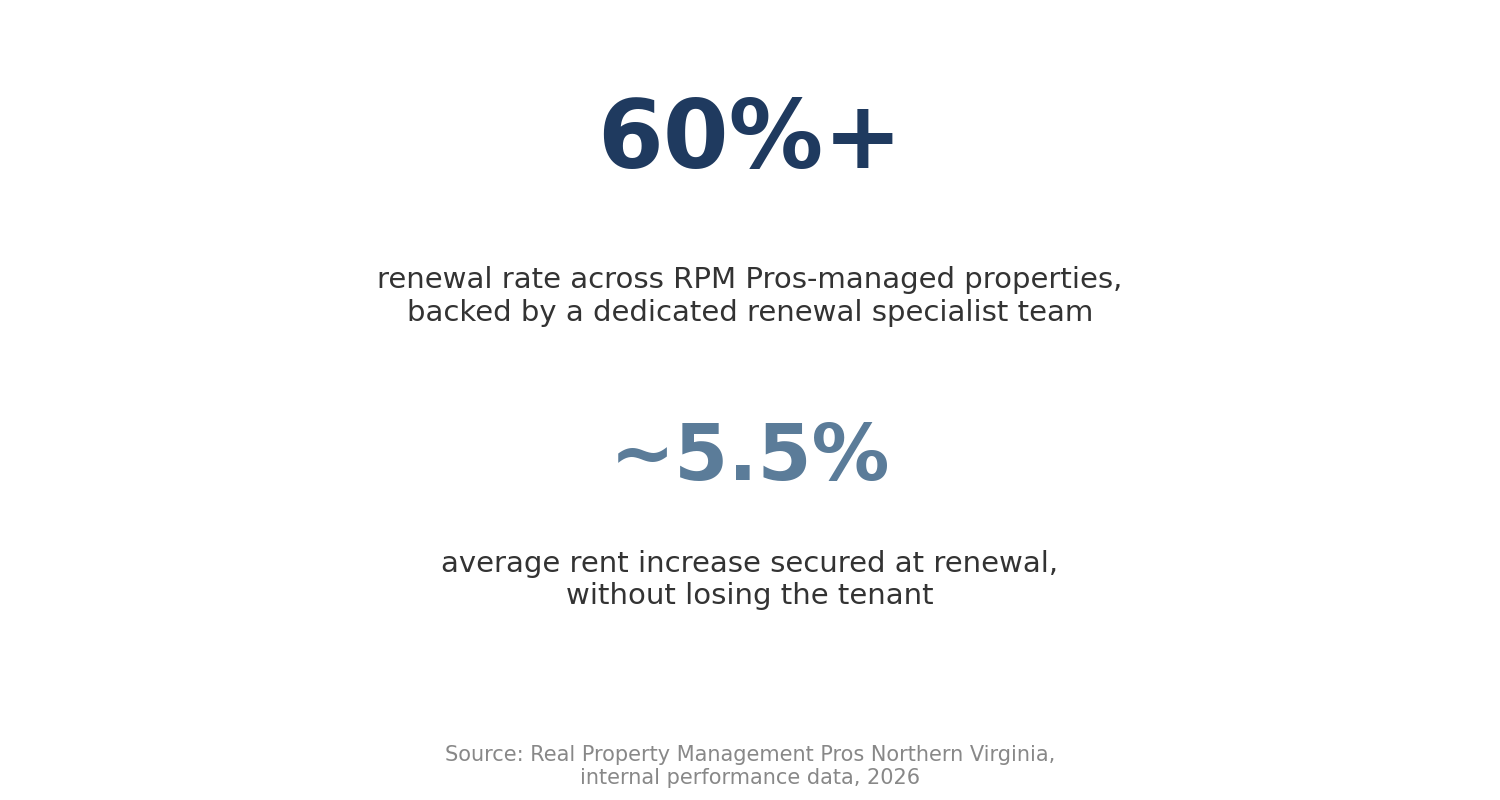
A tenant who renews is almost always cheaper than a tenant who leaves. Turnover means a vacancy gap, a make-ready cost to get the unit rentable, and the entire leasing and screening process again from zero. Self-managing landlords tend to under-invest in renewals because there is no dedicated time set aside for it. Renewal conversations happen reactively, close to the lease end date, instead of proactively.This is one area where a structured process is evident in the numbers.
“A renewal that happens because someone had a real conversation with the tenant weeks before the lease ended is a result you can repeat on every property, every year.” Marc Blackwood, Real Property Management Pros
Running Your Own Numbers
Whether self-managing makes sense for your property comes down to running through a simple worksheet. Start with a typical Northern Virginia management fee, typically 8% to 10% of monthly rent. Against that, add up your own honestly priced time, the cost of any vacancy days beyond what a professional process would likely produce, a reasonable allowance for deferred or emergency-rate maintenance, and the cost of turnover if your renewal rate is inconsistent. Compare the two totals, not the fee against zero.For a single property five minutes from home with a flexible schedule and a stable, long-term tenant, self-managing is the better math. For a portfolio, a property at a distance, a demanding job, or a run of bad luck with tenants, the numbers usually move the other way faster than expected.
Related Reading: Real Estate Investing in Northern Virginia: What Rental Property Returns Actually Look Like
If you want a second opinion on where your specific property lands, a property management cost comparison against your actual numbers is a practical next step, and our team is glad to walk through it with you.
Frequently Asked Questions: The Cost of Self-Managing a Rental Property
These are the questions we hear most often from Northern Virginia landlords weighing self-management against professional property management.Is self-managing a rental property actually cheaper than hiring a property manager?
Not automatically. There’s no monthly fee, but the real cost is on your own time, any extra vacancy days, deferred maintenance, and turnover if renewals are not handled proactively. For some landlords with one nearby property and time to spare, self-managing is genuinely the better math. For others, once all costs are honestly accounted for, a management fee ends up being the cheaper option.How much time does self-managing a rental property actually take?
It varies significantly by property, tenant, and how much goes wrong in a given month. The only way to find your number is to track it for a real month, including marketing, showings, screening, rent collection, and maintenance coordination, then price those hours at what your time is actually worth.What does DIY property management include?
DIY property management usually includes marketing the rental, showing the property, screening applicants, preparing the lease, collecting rent, responding to maintenance requests, coordinating repairs, tracking expenses, handling renewals, and staying compliant with landlord-tenant law.What is a typical property management fee in Northern Virginia?
Full-service property management fees in Northern Virginia typically range from 8 to 10% of monthly rent, though the exact figure depends on the property, services included, and the management company.What are the biggest risks of self-managing a rental property?
The most common risks are a longer average vacancy during leasing and screening, deferred maintenance that escalates into a larger repair, tenant screening mistakes that lead to a costly placement, and compliance missteps with Virginia landlord-tenant law, particularly around fair housing, notice requirements, and security deposits.Is managing your own rental property worth it?
Managing your own rental property can be worth it if you live nearby, have a flexible schedule, understand landlord-tenant requirements, and have reliable contractors. It becomes harder to justify when vacancy, maintenance delays, tenant issues, or compliance risk start costing more than the management fee you are trying to avoid.When does it make sense to switch from self-managing to a property manager?
Common signals include owning more than one or two properties, living far enough away that showings and maintenance calls are difficult to handle personally, a pattern of late rent or difficult tenants, or simply reaching a point where the time cost outweighs the savings once it is priced honestly.Serving Landlords across Northern Virginia
Self-managing can make sense for the right property and the right owner. But if vacancy, maintenance, tenant communication, screening, or compliance are taking longer than expected, it is worth running the numbers before the next problem arises.Real Property Management Pros helps landlords across the City of Alexandria, Arlington County, Fairfax County, Loudoun County, Prince William County, Fauquier County, and the Greater Fredericksburg Area compare self-management to professional property management based on real costs.
Article Sources
- RentCafe (Yardi Matrix). Virginia Rental Market Trends. July 2nd, 2026.
- Real Property Management Pros Northern Virginia. Internal renewal rate and rent increase performance data. 2026.
- Code of Virginia. Virginia Fair Housing Law (Title 36, Chapter 5.1). Accessed July 2026.
- U.S. Department of Housing and Urban Development. Guidance on Application of the Fair Housing Act to the Screening of Applicants for Rental Housing. April 29th, 2024.
- U.S. Internal Revenue Service. Publication 527: Residential Rental Property. March 30th, 2026.