


The same is true when you manage rental properties as a small portfolio. The tasks don’t change, but the number of deadlines, tenants, maintenance requests, and renewal decisions compounds quickly.
None of these tasks is complicated on its own. Marketing a vacancy or screening an applicant does not require special training. The difficulty is doing all seven consistently, every month, on top of a job and everything else already competing for your time. This guide walks through what the work actually involves, where Northern Virginia adds its own specifics, and how to tell when the job has outgrown what you want to keep doing yourself.
Quick Answer: What Does Managing a Rental Property Involve?
Managing a rental property involves marketing and leasing the unit, screening applicants, drafting and enforcing the lease, collecting rent, coordinating maintenance, conducting inspections, and managing renewals, all while staying compliant with Virginia landlord-tenant law throughout. Each task takes real time on its own. The risk comes from handling them inconsistently, not from any single task being difficult.If you want the cost side of this question rather than the task list, see The Real Cost of Self-Managing a Rental Property.
Key Takeaways
- Managing a rental property breaks down into seven core tasks: marketing and leasing, tenant screening, lease management, rent collection, maintenance coordination, inspections, and renewals.
- Legal compliance with Virginia landlord-tenant law is not a separate eighth task. It runs through screening, the lease itself, entry notice, security deposits, and habitability, all at once.
- Tenant screening and legal compliance pose the greatest risk when handled inconsistently. Rent collection and maintenance take up the most day-to-day time.
- Northern Virginia’s rental market moves quickly, and rents vary sharply by county, which makes a slow or inconsistent process more costly than in a slower-moving market.

Can You Manage a Rental Property Yourself?
Yes, you can manage a rental property yourself if you have the time, organization, local availability, and willingness to handle the work consistently. In Virginia, an owner does not need a real estate license to manage their own rental property. Licensing becomes an issue when someone manages property for another owner for compensation.The practical question is whether you can keep up with leasing, screening, rent collection, maintenance, inspections, renewals, and compliance without letting any part of the process slip.
The Seven Core Tasks, One at a Time
Here is what each of the seven actually involves once you get past the label.Marketing and Leasing
Getting a vacant unit in front of the right renters with accurate photos and a complete listing, then responding to inquiries and running showings quickly enough that good applicants do not move on to another property while they wait to hear back.Tenant Screening
Verifying income, running credit and background checks, and checking rental history, all against a consistent, written set of criteria applied the same way to every applicant. This is where the wrong shortcut costs the most later. See our guide Why Tenant Screening Is So Important for more information about this critical task.Lease Management
Drafting a lease that covers the specifics Virginia requires and making sure it’s signed correctly, then understanding the terms well enough to enforce them if something goes wrong. See our guide on what a property manager does for a broader look at how leasing, rent collection, maintenance, inspections, and renewals fit together.Rent Collection
Setting up a system before the first rent payment is due, then applying late fees consistently and following up on missed payments before they become a pattern. Our guide on how to collect rent effectively covers written policies, electronic payment options, and late-payment procedures in more detail.Maintenance Coordination
Responding to repair requests and keeping a working relationship with contractors, so emergencies do not mean calling around cold, and small issues get caught before they turn expensive. Learn how RPM Pros handles maintenance and repair management for Northern Virginia rental owners.Inspections
Documenting the property’s condition at move-in and checking on it periodically during the lease, then documenting the move-out condition clearly enough to support any deposit deductions if needed. If you want that part handled professionally, our rental property inspections service explains how inspections help document condition and identify issues before they become larger problems.Renewals
Starting the renewal conversation 60 to 90 days before the lease ends and deciding on a fair rent increase, so a good tenant has a real reason to stay rather than letting the lease lapse into month-to-month by default. A deliberate renewal process produces measurably better results than a passive one: across RPM Pros-managed properties, a dedicated renewal specialist team maintains a 60%+ renewal rate, with an average rent increase of roughly 5.5% at renewal, without losing the tenant.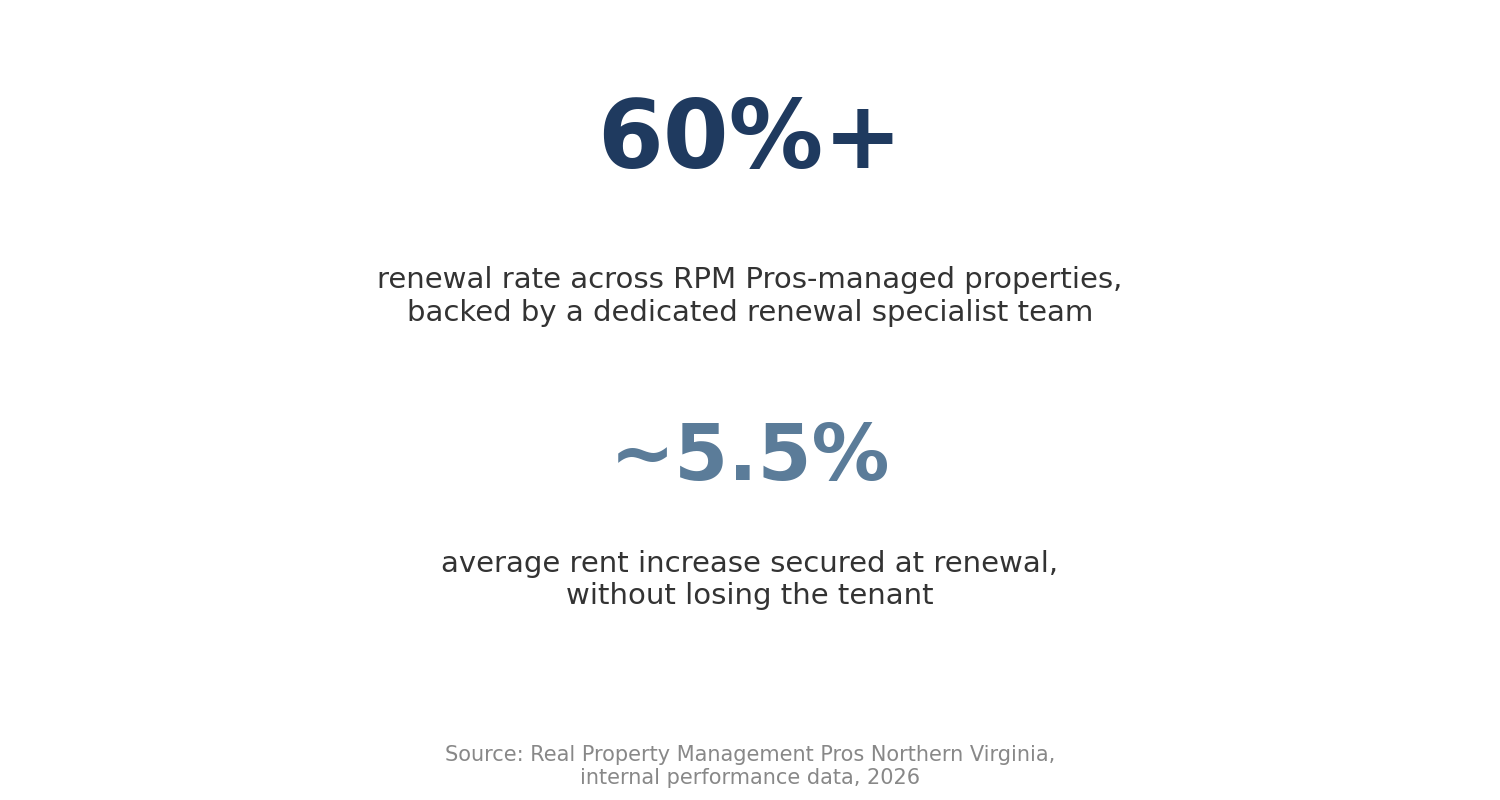
Rental Property Management Tasks at a Glance
Every stage of managing a rental property requires dedicated time, clear systems, and ongoing attention to detail. Here’s a simple breakdown of the core tasks a landlord must handle across the full lifecycle of a tenancy:| Task | What the Landlord Has to Manage |
|---|---|
| Marketing and leasing | Listing, photos, inquiries, showings, pricing, and vacancy timing |
| Tenant screening | Applications, income verification, credit checks, background checks, rental history, and written criteria |
| Lease management | Lease documents, signatures, terms, notices, renewals, and enforcement |
| Rent collection | Payment methods, due dates, late fees, reminders, and records |
| Maintenance coordination | Repair requests, contractors, emergency response, follow-up, and documentation |
| Inspections | Move-in condition, periodic checks, move-out documentation, and deposit support |
| Renewals | Renewal timing, rent review, tenant communication, and turnover prevention |
Where Northern Virginia Adds Its Own Complexity
Every landlord in every state deals with some version of these seven tasks. Northern Virginia adds a few specifics worth knowing before you run into them.Virginia’s landlord obligations are set out in the Virginia Residential Landlord and Tenant Act. Security deposits are one clear example of how specific it gets: a landlord cannot collect more than two months’ rent as a deposit, and once a tenant moves out, the law requires an itemized accounting of any deductions and the return of what is owed within 45 days, not whenever it becomes convenient. Notice periods and habitability standards carry their own specific requirements, and the Act is worth reading directly rather than relying on general national advice.
Rent levels also vary sharply within the region itself. RentCafe data shows average rents varying widely across Northern Virginia markets, from roughly the low $2,000s in cities such as Alexandria and Manassas to the high $2,000s in higher-cost areas such as Arlington and McLean. Pricing a unit correctly for its specific submarket, not the regional average, is part of the marketing and leasing task above.

That gap between submarkets is also why a slow response costs more in some parts of Northern Virginia than others. A delayed showing in a competitive, fast-absorbing submarket like Arlington or Fairfax risks losing an applicant to a comparable listing nearby. In a slower submarket, the same delay is less costly, but it still adds up over a full year of vacancies.
Where Self-Managing Landlords Most Often Get It Wrong
Most of the problems we see trace back to one of three habits, each manageable on its own until it becomes routine.Inconsistent Screening Criteria
Evaluating one applicant on gut feeling and the next on a strict checklist is a fair housing exposure risk if the inconsistency is ever challenged.Delayed Maintenance Response
A repair that gets pushed to next weekend rarely stays the same size while it waits. Deferred maintenance is one of the more expensive habits in self-management, precisely because the cost is invisible until the bill arrives.Passive Renewals
Waiting to see if a tenant renews, rather than starting that conversation proactively, produces a lower renewal rate than a deliberate process does. Turnover is one of the most avoidable expenses in owning a rental property.“Landlords run into trouble when one of these three things gets done inconsistently for long enough that it stops being an occasional slip and becomes the pattern the property runs on.” Marc Blackwood, Real Property Management Pros
A Simple Monthly Rhythm for Managing a Rental Property
The landlords who self-manage successfully tend to run the same rough rhythm every month rather than reacting to whatever comes up. Maintenance requests are acknowledged within 24 to 48 hours, even if the repair itself takes longer to schedule. Rent is reviewed on the same day each month, with late fees applied the same way each time they are owed. The property gets a walk-through or a check-in at a regular interval, not just when something seems off. Renewal conversations start 60 to 90 days out, not at the last minute.None of this requires special software or a big system. It requires doing it the same way every month. For a deeper look at what happens when this rhythm slips, and what it actually costs, see The Real Cost of Self-Managing a Rental Property.
“A rhythm is what separates a landlord who is managing a property from a landlord who is reacting to one. The tasks are the same either way. Whether they happen on a schedule or only when something forces the issue is the entire difference.” Marc Blackwood, Real Property Management Pros
When Managing It Yourself Stops Making Sense
A few signals tend to appear before a self-managing landlord decides to bring in professional help: owning more than one or two properties, living far enough away that showings and maintenance calls are genuinely difficult to handle personally, a pattern of late rent or difficult tenants that a stricter screening process should have caught, or simply reaching a point where the time these seven tasks take no longer feels worth it.If you’re at that point, a property management cost comparison against what self-managing is actually costing you, in time as much as money, is a practical next step.
Frequently Asked Questions: Managing a Rental Property
These are the questions we hear most often from Northern Virginia landlords managing or considering managing a rental property themselves.Is managing a rental property hard?
No single task is difficult on its own. Marketing a vacancy or screening an applicant is straightforward in itself. The difficulty is doing all seven core tasks consistently, every month, without letting any one of them slip.What is the most time-consuming part of managing a rental property?
It varies by property and season, but maintenance coordination and re-leasing a vacant unit after turnover tend to take the most concentrated time. Rent collection and routine inspections take less time individually, but need to happen every month without exception.Do I need a license to manage my own rental property in Virginia?
No. Virginia does not require a property owner to hold a license to manage their own rental property. A real estate or property management license is generally required to manage property on behalf of someone else for a fee.What happens if I manage my rental property incorrectly?
The consequences depend on what went wrong. Inconsistent tenant screening can create fair housing exposure. Mishandled security deposits or improper notice can violate the Virginia Residential Landlord and Tenant Act and expose you to tenant claims. Deferred maintenance can lead to higher repair costs or habitability disputes. None of these are guaranteed outcomes, but they are the most common ways self-management goes wrong.Can I manage a rental property remotely?
It is possible, but distance makes several of the seven core tasks harder: showings and maintenance emergencies typically require someone physically present, and periodic inspections are difficult to do properly from far away. Remote landlords often rely more heavily on local vendor relationships or hire out only the tasks that require on-site work.How do you manage rental properties if you own more than one?
The tasks are the same, but the complexity increases quickly. Each property has its own rent due dates, maintenance history, inspection schedule, lease terms, renewal timing, and tenant communication. Once you own more than one or two rentals, a written process or professional management support becomes much more important.When should I hire a property manager instead of managing it myself?
Common signals include owning multiple properties, living too far away to handle showings and maintenance personally, a pattern of tenant or rent-collection problems, or simply reaching a point where the time cost outweighs the savings from not paying a management fee.Serving Landlords Across Northern Virginia
Every landlord who self-manages eventually has to decide whether to keep refining the process or hand the work to a team that already runs it every day. Real Property Management Pros works with Northern Virginia landlords on both sides of that decision, whether you want a second opinion on how you’re already managing a property or you’re ready to hand these seven tasks to someone else.Article Sources
- LIS. Virginia Residential Landlord and Tenant Act (Title 55.1, Chapter 12). Accessed July 23rd, 2026.
- LIS. § 55.1-1226. Security Deposits. Accessed July 23rd, 2026.
- RentCafe (Yardi Matrix). Average Rent in Virginia. Accessed July 23rd, 2026.
- Real Property Management Pros Northern Virginia. Internal renewal rate and rent increase performance data. 2026.